Website Conversion Rate: The Silent Performance Killer
You optimize campaigns, fine-tune structures, test creatives – and performance still stagnates or even gets worse? PNO (your cost-to-revenue ratio) keeps rising, ROAS keeps falling, and you feel like there’s “nothing left to squeeze”? Maybe the problem isn’t your campaigns, but your website’s conversion rate. Read our new case study to find out why the technical state of an online store can wreck campaign performance across every channel – and why there’s no point scaling acquisition until it’s fixed.

In this article
- The client: acquisition that was supposed to grow but had nowhere to go
- The first warning sign: an extremely low conversion rate
- The limits of the partnership: when the website isn’t in your hands
- First results after launching the campaigns
- The turning point
- The fix: one change, immediate impact
- What changed after the server upgrade
- What to take away from this case study
You optimize campaigns, fine-tune structures, test creatives – and performance still stagnates or even gets worse? PNO (your cost-to-revenue ratio) keeps rising, ROAS keeps falling, and you feel like there’s “nothing left to squeeze”? Maybe the problem isn’t your campaigns, but your website’s conversion rate. Read our new case study to find out why the technical state of an online store can wreck campaign performance across every channel – and why there’s no point scaling acquisition until it’s fixed.
The client: acquisition that was supposed to grow but had nowhere to go
At the beginning of May, we took over a new online store in the e-commerce space (toys and learning aids). The goal was clear: significantly strengthen the acquisition side of marketing, which had long been neglected.
The previous agency had focused almost exclusively on remarketing, which limited the project’s further growth.
The client had active campaigns across all the key channels:
- Google Ads,
- Meta Ads,
- Sklik (the ad platform of the Czech search engine Seznam).
The first warning sign: an extremely low conversion rate
During the initial audit and our review of the data in Google Analytics, we ran into a major problem: an extremely low conversion rate across the entire website. It was most obvious in Direct and Organic traffic, but it was hurting all the performance channels too. In other words, this wasn’t a problem with one platform or badly set-up campaigns. The problem was systemic.
We repeatedly flagged this to the client and made it clear that without changes to the website, any attempt to scale acquisition would be severely limited. Even basic tools like PageSpeed showed very poor website performance.
The limits of the partnership: when the website isn’t in your hands
The key constraint was that full management of the website and hosting remained with the previous agency, which had no will to make technical changes, optimize anything or address performance itself. Our suggestions for improving the conversion rate were never proactively implemented on their side.
Even so, in line with the client’s goals, we gradually started launching acquisition campaigns, mainly on Google Ads and Meta platforms, with Seznam as a supplementary channel.
First results after launching the campaigns
When launching the new campaign structure, we expected a temporary rise in PNO. Reality turned out to be far worse than we expected:
- PNO rose dramatically,
- campaign optimizations brought no improvement,
- performance stagnated for a long time.
Over the following months, we were very actively optimizing and testing campaigns and coming up with new campaign structures, which could help bring the high PNO down, including mini UX/UI audits of the online store itself.
On the campaign side, we did everything that was possible. Even so, we didn’t manage to achieve the sharp reduction in PNO that was the main goal.
The turning point
In October, our analyst ran a deeper technical check of the online store’s infrastructure – specifically the hosting provided by the original agency.
The findings were critical:
- the hosting was completely inadequate (even for a small online store),
- the server components were far below minimum standards,
- the first page load routinely took 20–30 seconds.
That matched our everyday experience too – when clicking through from campaigns, the website often loaded extremely slowly.
The fix: one change, immediate impact
We clearly communicated the results of the analysis to both the client and the previous agency. It was obvious that the slow server was seriously destroying the conversion rate and no amount of campaign optimization could make up for it.
After firm pressure from the client, there was at least a significant increase in server performance thanks to a higher hosting plan. The result was an almost immediate positive impact on the conversion rate, which showed within a few days.
What changed after the server upgrade
Within a few days:
- the conversion rate started rising significantly,
- PNO dropped noticeably,
- campaigns started working more efficiently.
In Google Analytics, we saw:
- month-over-month improvement,
- positive year-over-year development,
- a clear trend across all channels, including Direct and Organic.
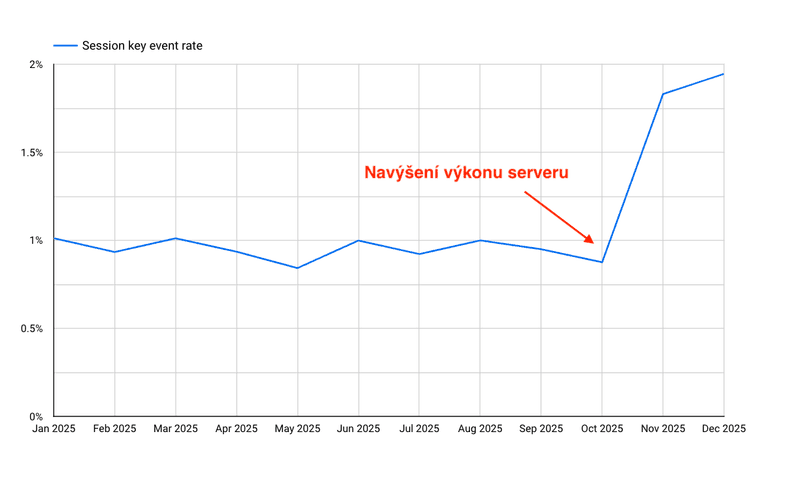
It turned out that the main brake on performance wasn’t the campaigns, but the technical state of the website.
What to take away from this case study
This project clearly confirmed one crucial thing for us:
Marketing performance doesn’t start or end in ad platforms.
Even though we were working across all channels with the maximum level of optimization, testing and scaling, the real cause of poor performance lay outside the campaigns themselves – in the technical state of the website, specifically inadequate hosting that severely slowed down the online store and, over the long term, destroyed the conversion rate across all traffic sources. As soon as server performance was increased, the changes showed up almost immediately:
- the conversion rate started to grow,
- PNO fell,
- campaigns could finally be managed efficiently, with a clear impact on revenue.
If you feel a similar problem might be holding back your online store too, get in touch – we’ll be happy to take a look.