Marketing Funnel: How to Acquire a Customer
Even the best ads won't bring you customers if the whole path from first contact to repeat purchase doesn't work. We explain what a marketing funnel is, which stages it has, what to measure in each one and why the funnel doesn't start with ads but with understanding your business and your customers.
In this article
If you want to sell online, it pays to understand one thing: ads on their own won't bring you customers if the whole buying process doesn't work. That's exactly what a marketing funnel describes. Read on to learn what it's made of, why each stage matters and how to find out where you're losing customers.
What is a marketing funnel?
A marketing funnel, also called a conversion funnel, is a model that describes how someone who has never heard of you becomes a paying, loyal customer. It has four basic stages: awareness, consideration, conversion and loyalty. At each stage the customer needs something different, and you measure something different.
A related term is the customer journey. It looks at the same process from the customer's side: their needs, questions, worries and feelings at every stage. The funnel is the company's view, the customer journey the customer's. Good marketing needs both.
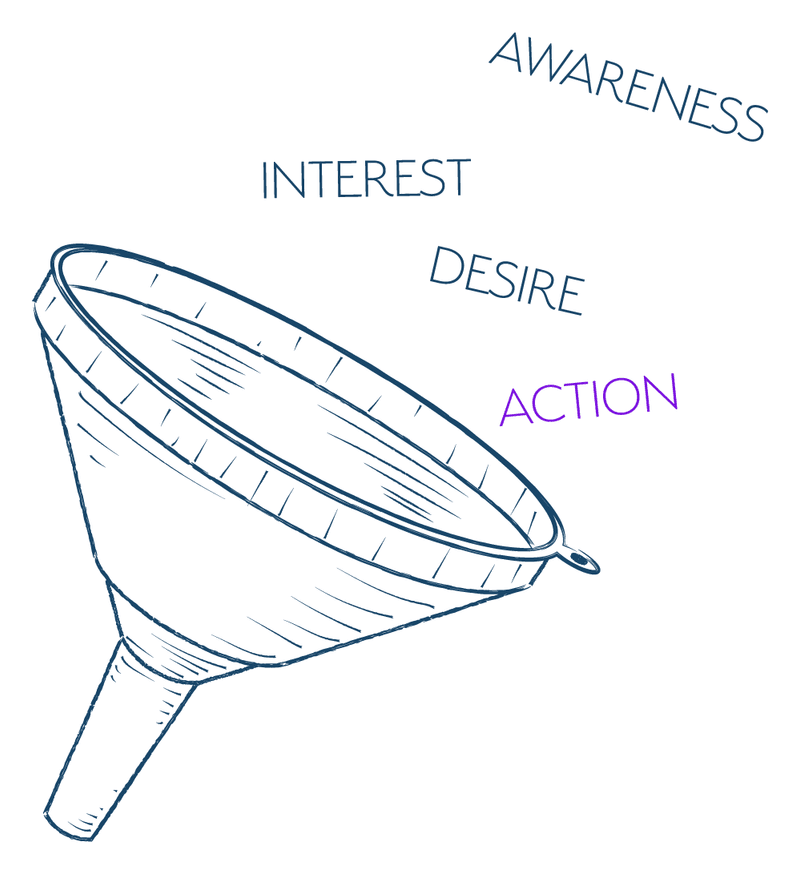
There are several well-known frameworks. Analyst Avinash Kaushik described on his blog the See-Think-Do-Care model, which splits the audience by intent: people with no commercial intent, weak intent, strong intent, and existing customers. The older AIDA model (attention, interest, desire, action) traces the path from attention to action. Whichever you choose, the principle stays the same.
One caveat: the funnel is a simplification. Google's research on the “messy middle” found that between the first trigger and the purchase, people switch between exploring options and evaluating them, often several times. So the path isn't a straight line from top to bottom. The funnel stages still help you understand what the customer needs at a given moment.
Awareness stage: attract the right people
In the awareness stage people first hear about you, usually through an ad, a social post, a video or an article. They aren't ready to buy yet, so the goal is to catch the attention of the right people, not to sell. That means knowing exactly who you're talking to, which problem you solve and why they should choose you.
If you sell notebooks, you might target university students with wide, hardback pads. Or you might focus on first-graders and their parents and add notebooks with cute animals on the cover. Each group needs a different message and different channels. And you should always be able to say what sets you apart from the competition.
It helps to show up in several places and keep the same style of communication and visuals. People remember a brand once they've come across it a few times and recognised it every time.
Consideration stage: answer every question
In the consideration stage the customer already knows about you but isn't sure yet that you have the right solution. They compare options, read reviews and look for answers to specific questions. Your job is to make the decision easier: answer everything that bothers them and put their worries to rest before they go to a competitor.
“Can I put this jacket in the washing machine?” “Isn't this software too complex for our company?” “Are Colombian or Brazilian beans better for espresso?” Put yourself in your customer's shoes and write down the questions, assumptions and worries running through their head. Then answer them: on product pages, in articles, in FAQs, in videos or in your ads.
References, reviews and real examples help too. Someone who is hesitating trusts other customers more than they trust you.
Conversion stage: make it simple
In the conversion stage the customer has decided to buy from you or send an enquiry, and you mustn't get in their way. A slow site, a hidden button, a long form or a broken payment is enough to make them leave. The path to purchase has to be fast, simple and work on both mobile and desktop.
Eureka! The visitor wants to buy. But where's the add-to-cart button? Why won't the card payment go through? Why has nobody replied to their enquiry yet? Every one of these details costs you orders, and the ad that brought the customer in is wasted.
The key is to measure at which step people drop off. In Google Analytics 4 you can use a funnel exploration, which shows the individual steps, such as viewing a product, the cart, checkout and purchase, and how many people stop at each one. Then you know what to fix first.
Loyalty stage: keep delivering value
In the loyalty stage you look after people who have already bought from you, so that they come back and recommend you. Keeping an existing customer is usually more worthwhile than winning a new one, because they already know and trust you. Helpful customer support, useful emails, after-sales care and offers that build on the first purchase all help.
Someone happy with your gloves may come back for a hat, a scarf and socks. Someone who likes your software may value consulting as well. Selling related products is called upselling and cross-selling. And a happy customer tells the people around them about you, so loyalty feeds the awareness stage again.
The relationship is most often kept up through email marketing, but loyalty programmes, looking after reviews and a community on social media belong here too.
What to measure at each stage of the funnel
Measure something different at each stage of the funnel, because each has a different job. For awareness, track reach and whether people know and search for your brand. For consideration, engagement and visits to key pages; for conversion, the conversion rate and drop-off at each step; and for loyalty, repeat purchases and customer lifetime value.
- Awareness: reach, frequency, branded searches, new website visitors.
- Consideration: visits to product and pricing pages, time on site, add-to-cart or wishlist, content downloads.
- Conversion: conversion rate, cart and checkout drop-off, cost per order or enquiry.
- Loyalty: share of returning customers, repeat purchases, customer lifetime value.
Kaushik points out that metrics should match the audience's intent. There's no point judging ads aimed at people who don't know you yet by immediate purchases. But without properly set up analytics and measurement, you won't even know which stages are working.
Approach your marketing as a whole: the funnel doesn't start with ads
A funnel doesn't work in pieces. If you pay for ads but people get lost on your website, you're throwing money away. And if you don't know who your customer is and how they buy, you don't know what belongs in each stage either. That's why the funnel starts not with ads but with understanding your business and customer behaviour.
For us this order has clear steps: first Business (goals, margins, what pays off), then Behavior (who your customers are, what they look for and where they drop off), then Branding (how to stand out and what to tell them) and finally Boost (campaigns that fill the whole funnel). You don't have to climb them with us, but it pays not to skip them.