Incremental Attribution: The End of Guesswork in Ad Performance? Meta Quietly Changed the Rules
How many of your sales would have happened even without expensive ad campaigns? Until recently, a precise answer was almost impossible to get. Not anymore. Over the past few months, Meta has quietly rolled out a feature that changes the rules of the game – automatic incrementality measurement.
In this article
How many of your sales would have happened even without expensive ad campaigns? It’s a question that keeps every marketer and business owner up at night. Until recently, a precise answer was almost impossible to get. Not anymore. Over the past few months, Meta has quietly rolled out a feature that changes the rules of the game – automatic incrementality measurement. We’ll show you what it means, how to read it and how to fit it into the bigger picture of your marketing.
What Is Incremental Attribution, Anyway?
Imagine you run an established store and hand out discount flyers. Standard attribution tells you: “100 people came in with a flyer and made a purchase.” Sounds great – but what if 80 of them were loyal customers who would have come in and bought anyway, flyer or no flyer? The real contribution of the flyer wasn’t 100 customers, but just 20 new ones.
And that’s exactly what incrementality addresses. While standard attribution shows correlation (the link between who saw an ad and who bought), incremental attribution reveals causation (who bought solely and only because they saw the ad).
The Big Change: Meta Measures Incrementality Automatically
In the past, getting this data meant running complex and costly Lift Tests. That has changed. In an effort to prove its real value at a time when cookies are being restricted, Meta has started automatically measuring incrementality in the background for many ad accounts.
How does it work? Simply. Meta deliberately leaves part of your audience out of the targeting and turns it into a so-called control (holdout) group. It then compares the purchase behavior of people who saw the ad with those who didn’t. The difference between them is your real, incremental contribution.
The feature was rolled out gradually and without any big announcements, which is why many marketers still don’t know about it – even though the data has long been sitting in their accounts.
How to View Incremental Data
Getting hold of this valuable data is surprisingly easy.
- Go to your Ads Manager on Meta.
- In the campaign overview, click the Columns button.
- From the menu, select Compare Attribution Settings .
- Next to your standard window, you’ll see an option to tick or select Incremental.
- Your report instantly splits into two columns and you’ll see the data side by side.
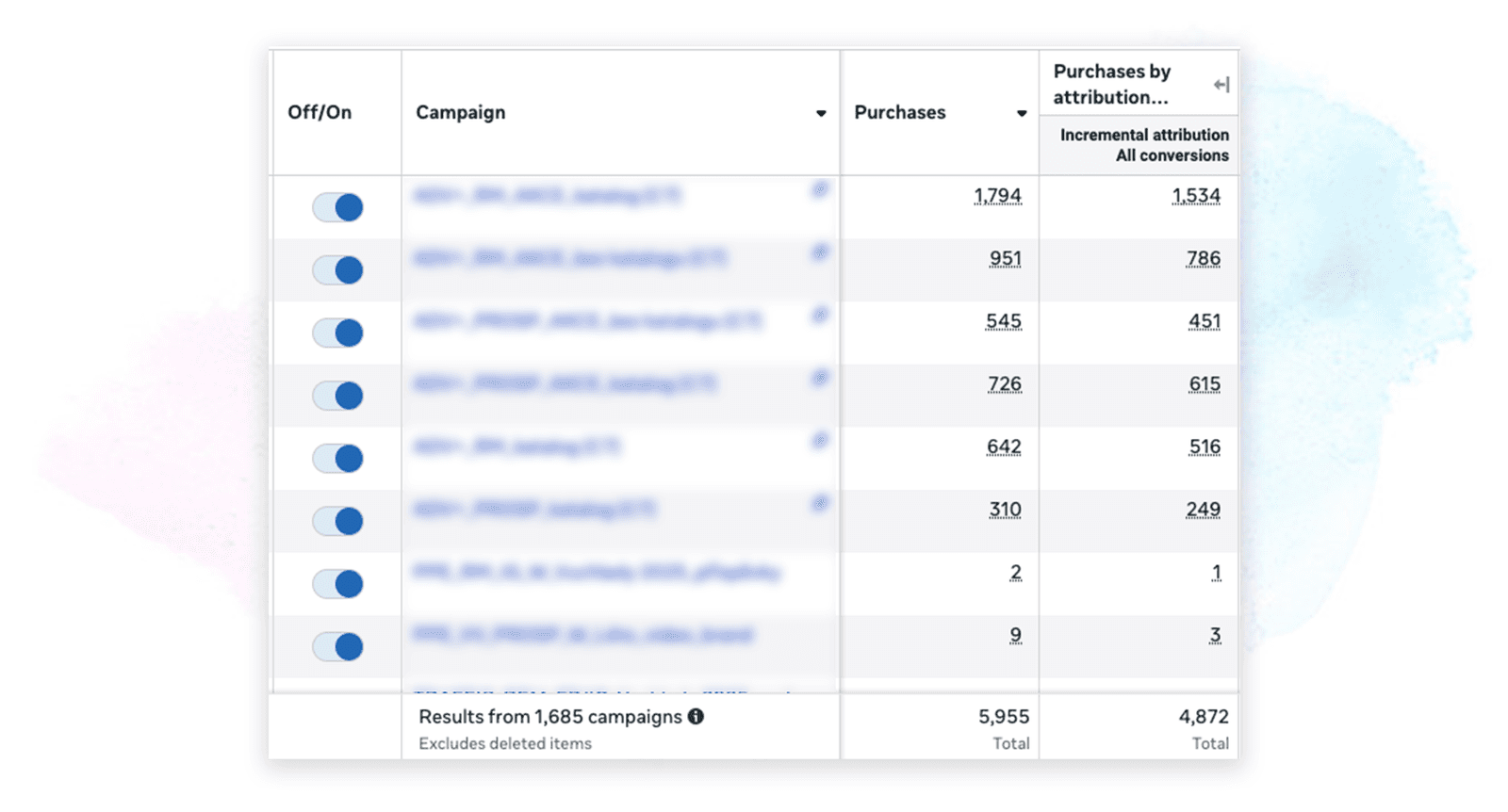
Screenshot from Meta Ads Manager showing two columns. The first, “Purchases”, shows a higher number, and the second, “Purchases (incremental attribution)”, a lower one – demonstrating the difference between standard and incremental attribution.
Real-World Case Study: Interpreting the Results
Imagine your campaign spent CZK 50,000 over the past month. You look at the report and see the following:
Metric | Standard view | Incremental view |
|---|---|---|
Number of purchases | 200 | 130 |
Cost per purchase (CPA) | CZK 250 | CZK 385 |
What do these numbers tell us? At first glance, it looks as if acquiring a customer costs you a great CZK 250. But the incremental data reveals the truth: 70 purchases (200 – 130) would have happened without your help. The real cost of acquiring one additional customer is therefore CZK 385. And that makes a huge difference when calculating your real profit and ROI.
Why Does This Matter for Your Business?
- You know your true ROI: You stop celebrating numbers inflated by organic purchases and start making decisions based on the real impact on your growth.
- Better budget allocation: You find out which campaigns, creatives or audiences actually bring in new customers and which just “collect” existing ones.
- Certainty in uncertain times: In an era when standard tracking is weakening, incrementality gives you proof of whether your marketing activities are working.
Don’t Forget the Big Picture: CRM and Other Channels
Incremental data from Meta is a great tool, but it’s crucial not to fall into tunnel vision and judge success solely through the lens of a single platform. Marketing works as an interconnected ecosystem.
- Marketing as a whole: Most customers interact with your brand in several places. They see an ad on Instagram, then search for you on Google, read your blog and finally buy after clicking through from your newsletter. Incremental data from Meta is great at showing Meta’s share of that success, but it can’t see the whole chain.
- Impact on other platforms: What happens if you cut your Meta budget based on incremental data? Reducing your Meta budget because of a lower incremental contribution can directly weaken your brand, which may show up as a drop in branded searches and direct traffic. So if you cut your Meta spend, keep an eye on whether your organic and direct traffic are dropping at the same time. You’ll only see the true impact of the change in the interplay of all your channels.
- CRM as the single source of truth: Your CRM is where you see a customer’s entire history. While Meta shows you the incremental first purchase, your CRM shows their lifetime value (LTV). You may find that Meta brings in customers at a higher cost, but they’re the most loyal ones with the highest LTV. And that’s information Meta alone won’t give you.
That’s why the best strategy is to combine both: use incremental data from Meta for tactical campaign optimization, but for big strategic decisions, always cross-check it against data from Google Analytics, your CRM and the overall development of your business.
Conclusion
The era of guesswork and estimates is slowly coming to an end. With automatic incrementality measurement, Meta is handing us a tool that lets us make smarter, data-driven decisions. It’s one of the biggest changes in reporting in years. Use it wisely and in the context of your entire marketing mix.
Take a look at your ad accounts today. You might be surprised by the story your data is really telling.
And if you’re not sure what to do with your newly discovered data or how to fit it into your overall strategy, we’re here for you! Just fill in the contact form and leave the data wrangling to us.