How to do Facebook and Instagram contests
Still running “like, share and tag a friend” contests? On Facebook, that breaks Meta’s rules. Read what Facebook’s and Instagram’s current terms say about contests, what your contest rules must include, which laws to keep in mind and how to set up a contest that actually helps your business.

In this article
Running a contest for your Facebook fans or Instagram followers is one of the most common things a business posts. Read on to find out what Meta’s current rules say about contests, what your contest rules must include, which laws to keep in mind and how to set up a contest that brings you more than a few likes.
“Like our Page, answer the question, tag a friend in your reply, like this post and share it on your timeline.” You have surely seen a contest like this. On Facebook, however, it breaks the rules, and it rarely does the business any good: it attracts plenty of people who care about the prize, not about you.
Which contest rules apply on Facebook and Instagram today
Facebook and Instagram both allow contests, but leave all the responsibility with the organiser, who needs official rules, eligibility terms and compliance with the law. Facebook also bans making entry conditional on sharing to a timeline or tagging friends. Instagram has no such explicit ban, but it forbids encouraging people to tag content inaccurately.
On Facebook, this is set out in the promotions section of the Pages, Groups and Events Policies. It gives “share on your Timeline to enter”, “share on your friend’s Timeline to get additional entries” and “tag your friends in this post to enter” as examples of what is not permitted. Promotions may run on Pages or in apps, not through personal timelines.
Instagram has its own Promotion Guidelines. Under them, the organiser is responsible for the official rules, the offer terms and eligibility requirements such as age and residency, and for compliance with the relevant regulations. You must not encourage people to tag themselves in photos they aren’t in. Both networks state that they won’t help you run the promotion and that you do so at your own risk.
Clarify the goal of the contest on Facebook or Instagram, then get started
Before you announce a contest, decide what it should achieve: more visits to your online store, sales of a particular product or awareness of a new brand. Many people managing business profiles skip this step, yet it is the foundation. Without a clear goal you won’t know whether the contest worked, and the prize is just a giveaway.
Why am I running a Facebook or Instagram contest?
Plenty of businesses run contests simply because their competitors do. That is pointless. The main goal shouldn’t be a bigger follower count either: the number may jump, but very few relevant people will join. Those are the ones that matter, the people interested in your website, products and services. A better goal is selling a specific product or building brand awareness.
How often do I want to do this?
Some Pages run giveaways practically non-stop. Here, too, less is often more. Once followers get used to endless contests, they lose interest, and however good the prize, the response will be weak. It is better to prepare something genuinely attractive every now and then that people will actually appreciate.
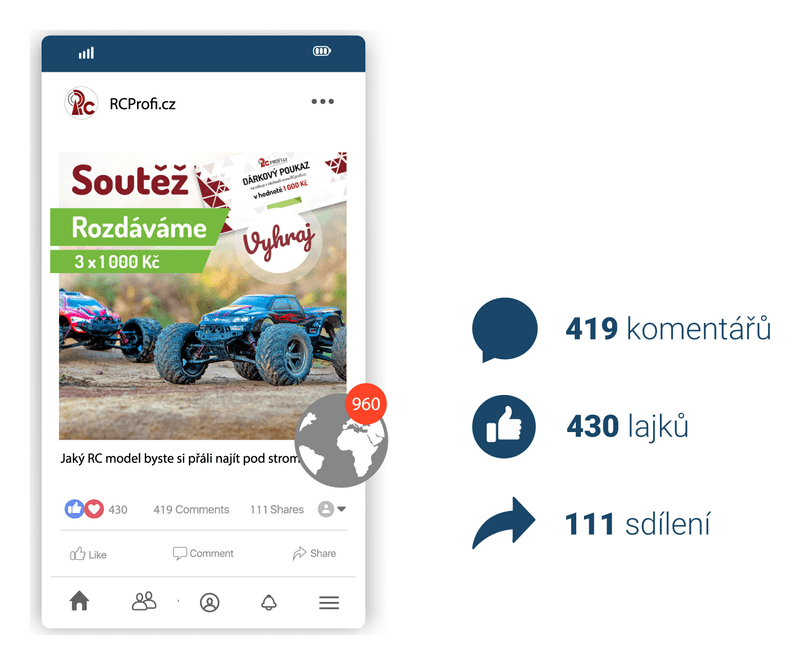
Take the pre-Christmas contest we ran for our client RC Profi, a shop selling remote-control models. The goal was to increase visits to the online store and boost sales. Participants were asked to write in the comments which RC model from the shop’s range they would like to find under the tree. Three randomly drawn participants won a gift voucher worth CZK 1,000. Within ten days the post had 419 comments, 430 likes and 111 shares. The campaign was very successful.
Follow the rules of Facebook and Instagram contests
Every contest needs written rules that are available before anyone takes part. A mistake in them can cost you your followers’ trust, lead to pointless disputes with participants and, at worst, cause trouble with Meta or the authorities. So what must a contest include to be watertight? Go through the following points one by one.
State all the rules and follow the law
Write down the full contest rules. They don’t have to be in the post itself; a link to a page on your website is enough. Cover who is running the contest, when it takes place, who may enter, what the prize is, how and when you will pick the winner and what happens if the winner doesn’t respond or turns the prize down. Also state that the winner is not entitled to a cash alternative. The contest must comply with the laws of the country where it runs.
Make sure the contest isn’t gambling
The Czech Gambling Act defines gambling as a game, bet or lottery in which the player places a stake whose return is not guaranteed and where the outcome depends wholly or partly on chance. A contest that people enter for free usually doesn’t meet this definition. If entry depends on a purchase or any other payment, have a lawyer review the rules.
You can change the rules, but say so
If the prize is tickets to a concert that is then cancelled, you need an alternative, such as a different prize. Mention in the rules that changes are possible, and when one happens, announce it as soon as you can and explain why. In sensitive situations like this, communication is key.
Point out that the social network has nothing to do with the contest
Both networks require this explicitly. State in the rules that the contest is in no way sponsored, endorsed or administered by, or associated with, Facebook or Instagram. The rules must also include a complete release of Facebook or Instagram by every participant.
Your obligations to participants and winners are yours alone
The whole contest is your responsibility, not Facebook’s or Instagram’s. Meta states explicitly that it won’t help you administer it. This, too, must be made clear in the rules.
Don’t forget about data protection
A winner’s name, delivery address or email are personal data. Under Article 13 of the GDPR, when you collect them you must tell people who is processing the data, for what purpose and on what legal basis. So state in the rules which details you need from the winner, why, how long you will keep them and that you will publish the winner’s name.
On these points the rules of both networks are similar. Where they differ is in which contest mechanics they allow. Let’s look at that now.
What not to do in Facebook and Instagram contests
On Facebook, don’t make entry conditional on sharing or tagging friends, and don’t run the contest through a personal profile. On both networks, don’t encourage inaccurate tagging, don’t give away alcohol without an age limit and forget about medicines entirely. And don’t assume breaking the rules is fine just because others do it.
The contest doesn’t belong on a personal profile
On Facebook, a contest may only run on a Page, whether a business, public figure or event Page, or in an app. Facebook’s policies explicitly rule out personal timelines and friend connections for administering promotions.
“Tag and share”? Not on Facebook!
Don’t make sharing on someone’s own or a friend’s timeline, or tagging friends in the comments, a condition of entering a Facebook contest. Lots of Pages do it, but that doesn’t make it acceptable. Facebook’s policies list exactly these mechanics as examples of what is not permitted.
Be very careful with alcohol and forget about medicines
Do you run an online store selling spirits and want to give away a bottle of whisky? State clearly in the rules that the contest is only open to people over 18 living in the Czech Republic and that by entering they confirm this. The contest must not encourage excessive drinking. Rules for medicines and similar products are even stricter, so don’t run contests involving them at all.
Social networks also change their rules. If you want to be sure you are doing everything right, read them again at the source before every new contest.
Instagram’s contest rules are looser, but still be careful
Instagram’s guidelines don’t contain the explicit ban on sharing or tagging friends that Facebook has. Asking people to tag a friend in the comments therefore doesn’t break them in itself. What is forbidden is encouraging inaccurate tagging, such as people tagging themselves in photos they aren’t in. Official rules and the statement that Instagram isn’t involved still apply.
Neither network explicitly forbids making a follow a condition of entry. Its value is questionable, though: many people follow only for the prize and leave once the contest is over, or stop paying attention to your posts. You get a higher follower count, not an audience that actually cares about you. Likes aren’t everything.
A contest is one tool, not a strategy. If it is meant to drive sales, it has to connect to what people see next: your website, your offer and the rest of your communication. Read how we fit contests and other content into the bigger picture in our social media management service.