11+1 useful tips for writing posts on Facebook and Instagram
Anyone can write a Facebook or Instagram post. Writing one that people read to the end, save and share is a craft. Here are 11+1 tips updated for 2026: from the opening line to Reels and carousels and what Meta says decides your reach today.

In this article
- What decides who sees your post today
- 1.Grab the reader’s attention immediately, or never
- 2.Important information comes first. Always
- 3.Paragraphs aren’t the enemy – they’re a must
- 4.Not too long, not too short. The text should be just right
- 5.Choose your communication style carefully and stay consistent
- 6.Pay attention to spelling, grammar and typos
- 7.Don’t overdo it with emojis, and choose them wisely
- 8.Be authentic
- 9.Use more than just photos
- 10.Educate and entertain with your content
- 11.Follow trends and adapt to them
- And one more tip: engage in the discussion
For most businesses, Facebook and Instagram are still where they meet their customers every day. Here is how to write a post that makes people stop, read to the end and maybe pass it on. We first wrote these tips in 2022 and updated them in 2026 based on what Meta itself now says about reach.
“We take all the information we have and knead it into one smooth dough. Then we roll out a nice long post and sprinkle it generously with all kinds of emojis. Finally, we garnish it with a pretty picture. They grow everywhere on the internet, so it’s easy to pick one.” And there’s our recipe for the perfect post. Or is it?
Ask yourself whether you would want to read a post made from that recipe. After a few words you would probably get lost in a jumble of lines full of hearts and animals. So let’s look at what decides reach today and how to put your time into a post that engages readers and brings them to your website or online store.
What decides who sees your post today
Instagram says it ranks posts by predicting how you will react to them: whether you spend a few seconds on a post, like it, comment, save it or send it to someone. For Reels it also predicts whether you will watch to the end. You write for people, not for the algorithm. The algorithm just measures whether you succeeded.
Instagram’s head Adam Mosseri laid this out in Instagram Ranking Explained: Feed, Stories, Explore and Reels each use their own signals. Reels that were already posted on Instagram and watermarked videos get less visibility. In 2025 Meta also took a harder line on unoriginal content on Facebook: accounts that repeatedly reuse other people’s videos, photos or text without adding anything of their own lose reach on everything they share.
1. Grab the reader’s attention immediately, or never
People scrolling through their feed decide in a moment whether to read your post. The first sentence, the first second of a video or the first slide of a carousel has to say what the post is about and why it matters to the reader. If they hesitate, they scroll on, however good the rest of the text is.
In text, it helps to open with a concrete benefit or a question the reader is already asking. In video, the same goes for the picture: show the result first, not your logo and a long intro. Instagram predicts whether people will watch a reel to the end, so a weak start costs you reach as well.
2. Important information comes first. Always
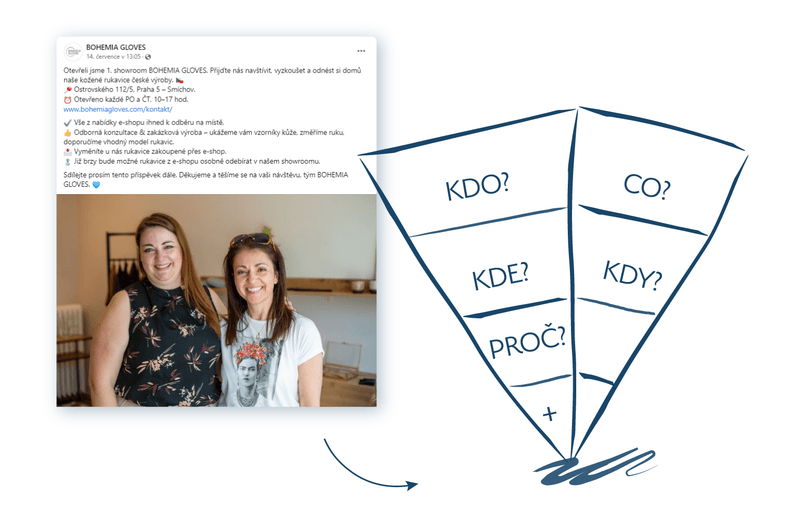
Rank what you want to say by importance and put the most important thing first. The inverted pyramid helps: the main message at the top, details below it, extras at the end. Facebook and Instagram cut longer captions short and hide the rest behind a link to expand them, so the first lines have to work on their own.
3. Paragraphs aren’t the enemy – they’re a must
A wall of text is the most reliable way to drive people away before they even start reading. Break your post into short paragraphs, ideally one idea per paragraph, with a blank line between them. On a phone screen, a long block of text turns into a grey wall that hardly anyone reads to the end.
4. Not too long, not too short. The text should be just right
A post should be long enough to say everything important and not a word longer. Four words and three emojis say nothing, and a forty-line essay bores everyone. One rule still holds: one post, one topic. Several topics in one post only confuse the reader and blur what you wanted them to remember.
Longer text makes sense where it carries value: a how-to, a process or a customer story. In a carousel or a reel, the picture carries the main message and the caption adds context and a call to action.
5. Choose your communication style carefully and stay consistent
Match the tone of your posts to your business and your customers, then keep it the same across posts, comments and ads. A lingerie shop can afford to be playful, though never vulgar, while a tool seller will be more matter-of-fact. A consistent style makes the brand recognisable even when people don’t see the logo.
It helps to write your tone down: how you address people, which words you use and which you avoid. There is more on this in our glossary entry on tone of voice.
6. Pay attention to spelling, grammar and typos
A social media post is business communication just like an email or a flyer. Wrong capitals, missing commas or sloppy punctuation suggest you didn’t care, and that impression rubs off on the whole company. Before you publish, read the post once more, ideally out loud, or ask a colleague to read it for you.
Spell checkers and AI tools will catch typos, but they won’t check the tone or the facts for you. Text generated without human editing also tends to sound generic and impersonal.
7. Don’t overdo it with emojis, and choose them wisely
Emojis liven up a post, but too many do more harm than good. Use them sparingly and with purpose, for example as bullet points in a list or to highlight one idea, not as decoration after every sentence. Three or more mismatched emojis in a row won’t improve the text; they just make it harder to read.

8. Be authentic
People on social media aren’t looking for a catalogue; they want inspiration, entertainment and other people. Instead of polished studio product shots, show real people, what happens behind the scenes and customers using your products. No stock photos: your content should look as if your customers could have made it, not an ad agency.
Content made by your customers, known as UGC, is ideal for this. Just ask the author for permission before you use it. Being authentic doesn’t mean reposting other people’s content, though. Meta says that Pages and profiles get the greatest distribution when they consist primarily of original content.
9. Use more than just photos
Photos alone are no longer enough. Instagram and Facebook offer short Reels, carousels with several slides, Stories that last 24 hours and live video. Each format suits a different job, and Instagram ranks each one by slightly different signals, so mixing formats gives you more chances to reach new people as well as existing followers.
- Reels – short videos that reach people who don’t follow you yet. Instagram predicts whether you will watch them to the end, like them or send them on.
- Carousels – several slides in one post. Good for how-tos, step-by-step guides or comparisons people come back to.
- Stories – behind the scenes, quick news and interactive elements such as polls or questions. They are seen mainly by people who already engage with you.
- Live video – interviews with experts in your field, live Q&As or a product launch.

10. Educate and entertain with your content
A business profile should build an audience that picks you over the competition. The best way to do that is content that is useful even without a purchase: practical tips, how-tos and answers to questions your customers keep asking. People save and share this kind of content, and Instagram treats saves and shares as signals of interest.

And entertaining content? Let’s admit it: we would rather read stories that end in disaster than success stories. Ask your followers to share their worst experience with … (fill in whatever fits your field). Just avoid cheap prompts like “comment YES if you agree”. People see through them and they don’t start a real conversation.
11. Follow trends and adapt to them
What people enjoy on social media changes fast, both formats and topics. Watch what works in your field and beyond, and try to adapt it in your own way. That doesn’t mean jumping on every trend: if it doesn’t fit your brand, it looks forced. Pick the trends you can fill with content of your own.
Hashtags have changed too. According to its Help Center, Instagram now lets you add up to five hashtags to a post, so “the more, the better” is long gone. Use only the ones that describe the content precisely. It matters more that the caption and the visual make it clear what the post is about.
And one more tip: engage in the discussion
When a discussion starts under your post, join in and reply, ideally quickly and to the point. Comments are among the signals Instagram uses to predict interest in a post. More importantly, they show everyone else that there are real people on the other side who listen. That applies to negative comments too, which you can’t simply ignore.
Answer criticism honestly and offer a solution. Don’t attack, don’t ignore it and don’t delete it. Even when you are right, don’t let irritation take over: an annoyed reply easily attracts trolls, and one comment turns into a thread that does more damage than the original complaint. Delete spam and abuse, not awkward questions.
A good post is only one piece. Organic posts often feed paid campaigns too, and a weak caption or visual then drags down the results of the ads. Read how we connect social media to business goals in our social media management service.